Yasmin Bilal
Africa is facing a renewed Ebola emergency, with President Cyril Ramaphosa calling for urgent, coordinated action to contain the outbreak in parts of the Democratic Republic of the Congo and Uganda.
He was speaking at a High Level Meeting of African health ministers convened by Africa CDC to address the Bundibugyo Ebola outbreak. The meeting brought together continental leaders, health experts and global partners.
Ramaphosa warned that the situation remains serious, noting that the outbreak is unfolding in areas affected by insecurity, population movement and porous borders, which is complicating containment efforts.
“Africa is once again being tested by a dangerous Ebola outbreak affecting the Democratic Republic of the Congo and Uganda, with a serious risk of wider regional transmission,” he said.
The outbreak has already claimed more than 200 lives, according to Africa CDC assessments.
Regional and global health leaders attended the meeting, including John Dramani Mahama, Mahmoud Ali Youssouf, Jean Kaseya and Tedros Adhanom Ghebreyesus.
Ramaphosa paid tribute to frontline health workers, saying they continue to serve under extreme pressure, and called for stronger protection through adequate staffing, protective equipment and rest periods.
He praised Africa CDC for its rapid coordination of the continental response, saying it had helped mobilise affected countries and strengthened joint operations with the World Health Organisation.
He also commended the Democratic Republic of the Congo, Uganda and South Sudan for choosing cooperation during the crisis.
“At a moment of uncertainty, these countries chose cooperation over isolation and unity over fragmentation. This is the Africa we must continue to build,” he said.
Ramaphosa noted that there are currently no widely available vaccines or therapeutics for the Bundibugyo strain, although work is underway on vaccine and treatment candidates through partnerships involving Gavi, CEPI and Unitaid.
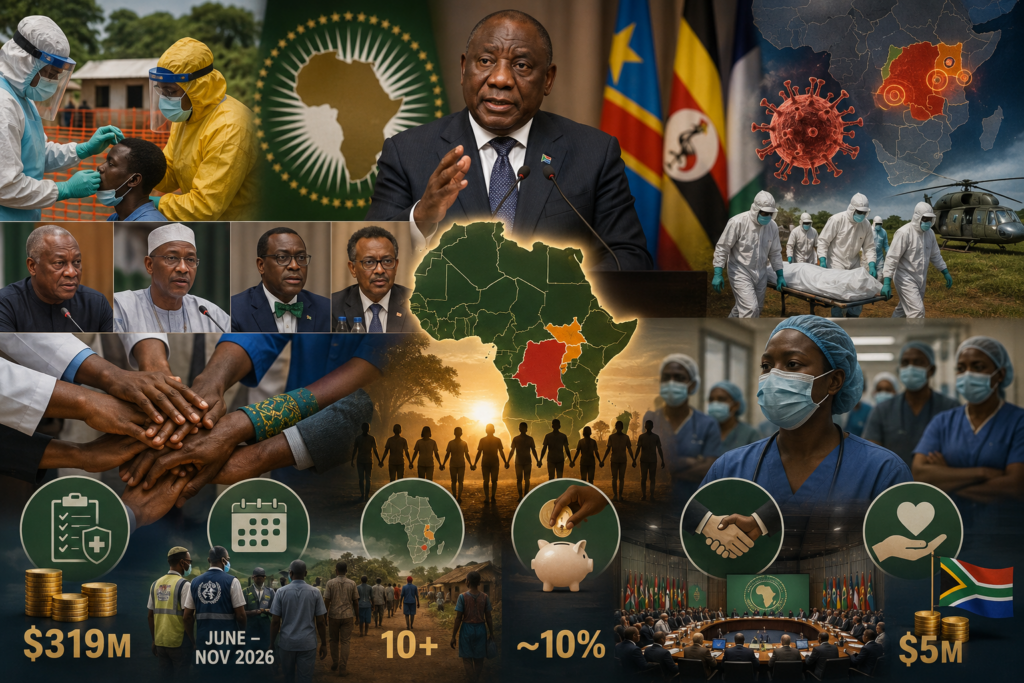
African health ministers have backed a $319 million continental response plan. The programme will run from June to November 2026 and support outbreak control and preparedness in at least ten high-risk countries.
Member states have already pledged around 10 per cent of the required funding through domestic contributions.
South Africa has also announced an initial $5 million contribution to the Africa CDC to support the response effort.
Ramaphosa urged wider international support, saying global cooperation is essential to prevent further loss of life.
“The world is safer when Africa is safer,” he said.
He added that Africa has the institutions and expertise to respond, but that speed, unity and sustained solidarity are now critical.