Thokozile Mnguni
Consumers are continuing to tighten their budgets as the rising cost of living places an increasing strain on household finances.
Fresh data from TransUnion Africa indicates that many households are prioritising essential spending, reducing discretionary purchases and making greater use of credit to manage monthly expenses.
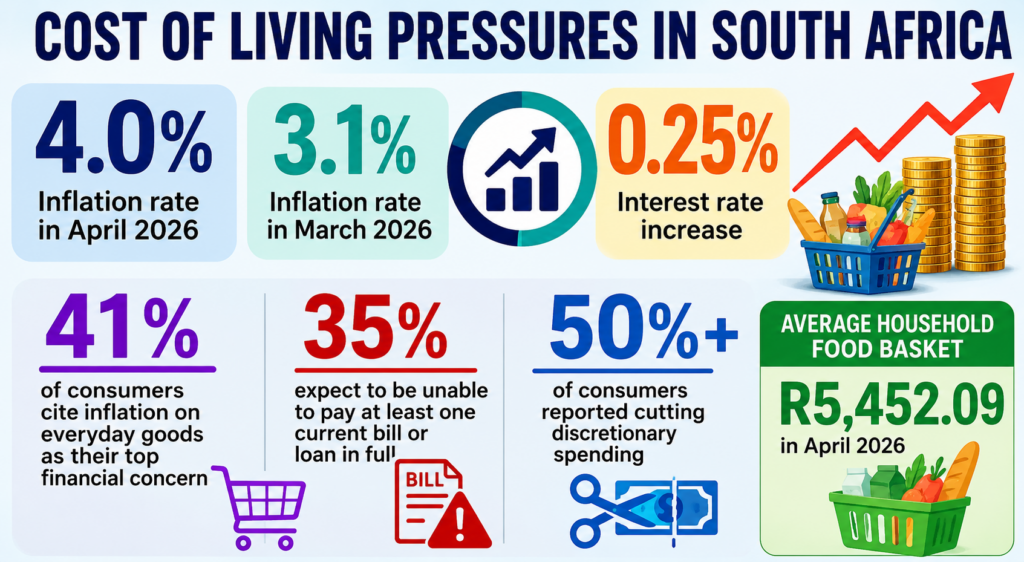
The update follows the South African Reserve Bank Monetary Policy Committee’s decision to raise interest rates by 25 basis points. Inflation also climbed to 4.0% in April, up from 3.1% in March.
TransUnion Africa Chief Executive Officer Lee Naik said the latest increase adds to already elevated financial pressure on consumers.
“A 0.25% increase lands on households that are already under strain. This is not a new shock; it is an amplification of pressures that consumers are already managing,” said Naik.
He noted that higher fuel prices, rising food costs and increased borrowing expenses continue to weigh on household budgets.
Findings from TransUnion’s Q1 2026 Consumer Pulse Study show that inflation on everyday goods remains the leading financial concern among consumers, with 41% of respondents identifying it as their top worry.
The study also found that 35% of respondents expect they will not be able to fully pay at least one bill or loan in the near term.
Spending patterns continue to shift, with more than half of respondents reporting reduced discretionary spending. Others are prioritising debt repayment or building emergency savings.
TransUnion reported that the average household food basket rose to R5,452.09 in April 2026, driven largely by higher fuel and logistics costs.
The report highlights ongoing financial vulnerability, particularly among consumers relying on non-bank lending products.
Naik said the data reflects a longer-term adjustment in behaviour rather than a response to short-term shocks.
“What we are seeing is a structural shift in behaviour, where households are increasingly prioritising essentials, protecting debt commitments and managing risk more cautiously,” he said.
TransUnion said households are expected to remain cautious in their spending, saving and credit usage as affordability pressures persist.
A news desk team spoke to shoppers about the rising cost of living.
Maria, a pensioner, said it is frustrating to go shopping and leave with only a few items.
“Things have become so expensive. Some days I have to choose between eggs and chicken. These prices are very depressing,” she said.
Another shopper, Thuli, said rising costs have made it difficult to prioritise household needs.
“Imagine going into a clothing store and only being able to buy for two of your children instead of all three. It is winter now, and we have to keep our kids warm,” she said.
A third shopper, who works for a large company, said that after deductions are taken from her salary, she is left with just enough for groceries for a week.
“I cannot even get a credit card, so I go to money lenders to survive the rest of the month. It is hard,” she said.