Yasmin Bilal
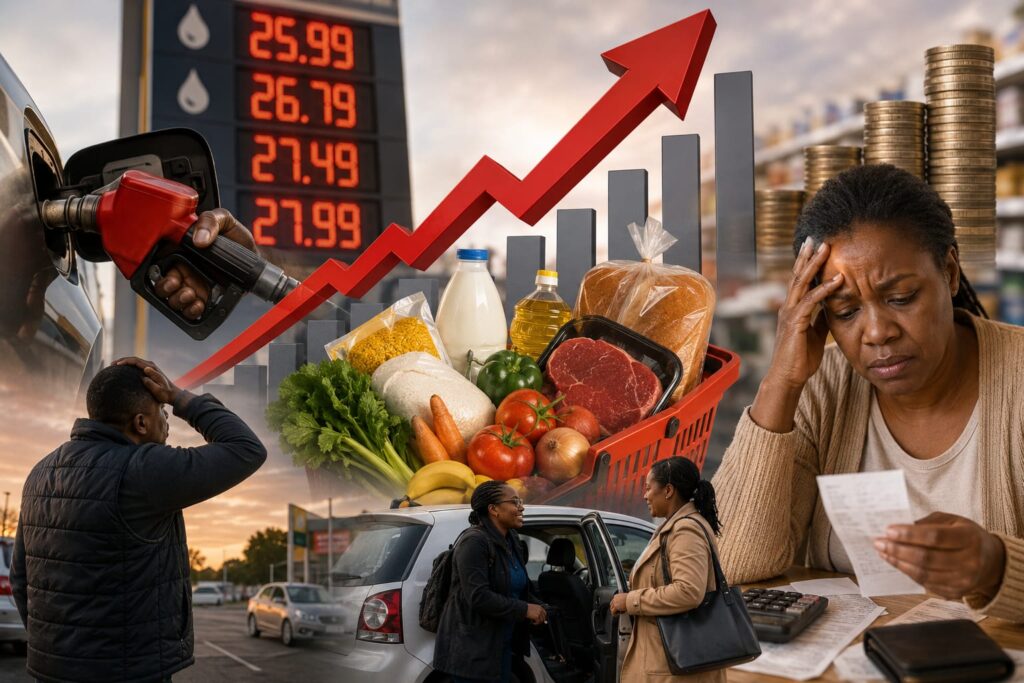
Consumers faced higher costs in May as rising fuel prices pushed inflation to its highest level in nearly two years, despite continued relief in several food categories.
Annual consumer inflation rose to 4.5% in May 2026, up from 4.0% in April, according to figures released by Statistics South Africa.
The increase marks the highest inflation rate since July 2024, when inflation stood at 4.6%. Every month, the Consumer Price Index (CPI) increased by 0.7% in May.
Statistics South Africa said the latest rise was driven largely by higher fuel prices. The fuel index recorded a second consecutive sharp monthly increase, rising by 14.3% in May. On an annual basis, fuel prices were 28.7% higher than a year ago.
Petrol prices increased by 24.8% over the past 12 months, while diesel prices surged by 53.8% during the same period.
The impact of fuel costs on overall inflation was highlighted by the CPI excluding fuel, which remained unchanged at 3.7% year on year.
The measure has fluctuated within a narrow range of between 3.5% and 3.8% over the past year. The monthly increase for the index was 0.2% in May.
Food and non-alcoholic beverage inflation continued to ease, slowing to 1.9% from 2.9% in April. The latest figure is significantly lower than the 5.7% peak recorded in July 2025.
Prices for several staple food items also showed signs of moderation. Annual deflation for cereal products deepened to minus 1.4% from minus 1.2% in April. Maize meal was 4.4% cheaper than a year ago, while brown bread prices were down by 0.3%.
Meat inflation also cooled. The annual rate slowed to 7.3% in May from 9.4% in April, while prices declined by 0.8% every month. Stewing beef prices fell by 3.0% between April and May, while beef mince declined by 2.4%.
Fruit and vegetable prices remained lower than a year ago. Statistics South Africa recorded annual deflation of 8.5% for fruits and nuts and 6.0% for vegetables. Both categories have remained in negative territory since October 2025.
Some food categories, however, continued to record increases. Inflation for milk, dairy products and eggs rose to 0.9% from 0.1% in April. Full cream long-life milk increased by 1.7% month on month, while low-fat fresh milk and cheddar cheese each rose by 1.5%.
The annual inflation rate for the “other food” category increased to 4.9% from 4.1%. Products recording notable increases included salad dressing, mayonnaise and salt.
Non-alcoholic beverages also became more expensive. Inflation in the category rose to 4.9% from 4.6% in April. Prices for both Ceylon tea and rooibos tea recorded stronger annual increases during the month.
Consumers expressed frustration over the rising cost of living, saying household budgets are under increasing pressure.
One administrative clerk from the south of Johannesburg, who travels daily to Heidelberg for work, said rising fuel costs had forced her and her colleagues to adjust how they travel.
“With petrol prices where they are, my friends and I decided to use one car and travel to work as a group. It really is bad. Food is already a struggle, so there is no point travelling in different cars with the current state of everything going up,” she said.
Another consumer from Sophiatown, who works in Centurion, said her income no longer stretches far enough to cover basic expenses.
“My salary is not salarying anymore because everything is expensive. One has to focus on the main things, which are food, transport and school fees. I have stopped paying some of my loans and debts because I simply cannot afford them anymore,” she said.
“Imagine if I, who is working, can complain. What about unemployed people? I wonder how they survive. Things have become terrible in our country. I never thought I would see myself buying only the bare essentials. Before, I could stock up my fridge and fill my car’s tank without worrying,” the consumer said.
Many other consumers who spoke to the News Desk team echoed similar concerns, saying rising living costs are making it increasingly difficult to cover basic household expenses.