Thokozile Mnguni
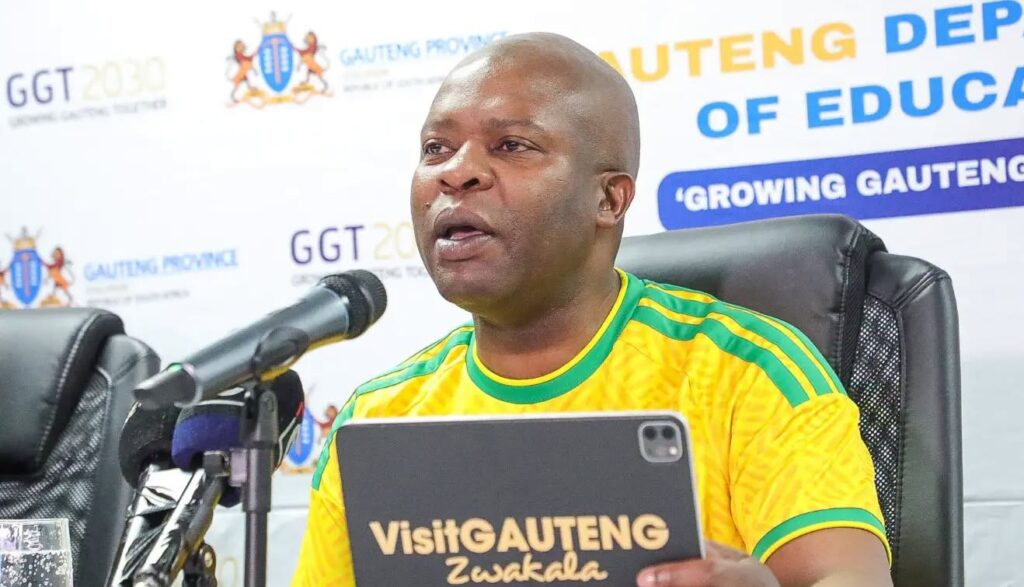
The Gauteng MEC for Education, Sport, Arts, Culture and Recreation, Lebogang Maile, has announced that the Department will implement immediate measures to confront corruption, financial mismanagement, procurement irregularities and wider governance breakdowns in public schools.
Speaking to the media today, Maile said the Department has already initiated an internal investigation.
It focuses on allegations that some officials may be conducting business with the state through proxies, relatives or undeclared company interests.
He added that internal financial controls are being reinforced. The aim is to strengthen oversight and ensure school funds are used strictly for education-related needs.
“People who deal with school finances, including principals and members of School Governing Bodies, must be vetted. This will include the conducting of criminal record checks, financial background checks, conflict of interest declarations, qualification verification and competency assessments,” he said.
Maile warned that school financial management requires strict supervision and cannot be handled informally or without strong controls.
“Large budgets often running into millions of rands are managed in environments where financial controls are sometimes inadequate. Oversight is inconsistent, and accountability mechanisms are vulnerable to manipulation.”
He said an internal assessment has identified 41 serious cases. These involve principals, School Governing Body members, finance officers, bursars, administrative staff, educators, general workers and service providers.
“These are individuals and structures entrusted with public money, learner welfare, infrastructure, nutrition, teaching resources and the daily functioning of schools and of the 41 cases recorded, 22 occurred in 2023, accounting for 54 per cent of the total,” he said.
According to Maile, 13 cases were recorded in 2025, representing 32 per cent of the total.
“By June 2026, six new cases had already emerged, accounting for 14 per cent. This indicates that while the number of recorded cases is fluctuating, the problem remains active. Corruption has not disappeared. It remains embedded in parts of the system,” he explained.
He said the identified methods of misconduct are largely consistent across cases.
These include inflated invoices, duplicate quotations, unauthorised withdrawals, cash payments without proper documentation, procurement outside approved processes and payments for goods not delivered.
The Department has also raised concern over corruption linked to scholar transport, suspected theft of school resources and undeclared donations made to schools.
“The Department will intensify cooperation with the South African Police Service, the Directorate for Priority Crime Investigation (the Hawks), the Gauteng Provincial Treasury, as well as departmental Labour Relations and Risk and Compliance units. As stated, government departments must investigate corruption by following a strict multi-agency, transparent framework mandated by national legislation,” said Maile.
“We will collaborate with and refer cases to external anti-corruption bodies that are legislatively mandated to investigate and prosecute corruption, fraud and unlawful activities,” he concluded.