Yasmin Bilal
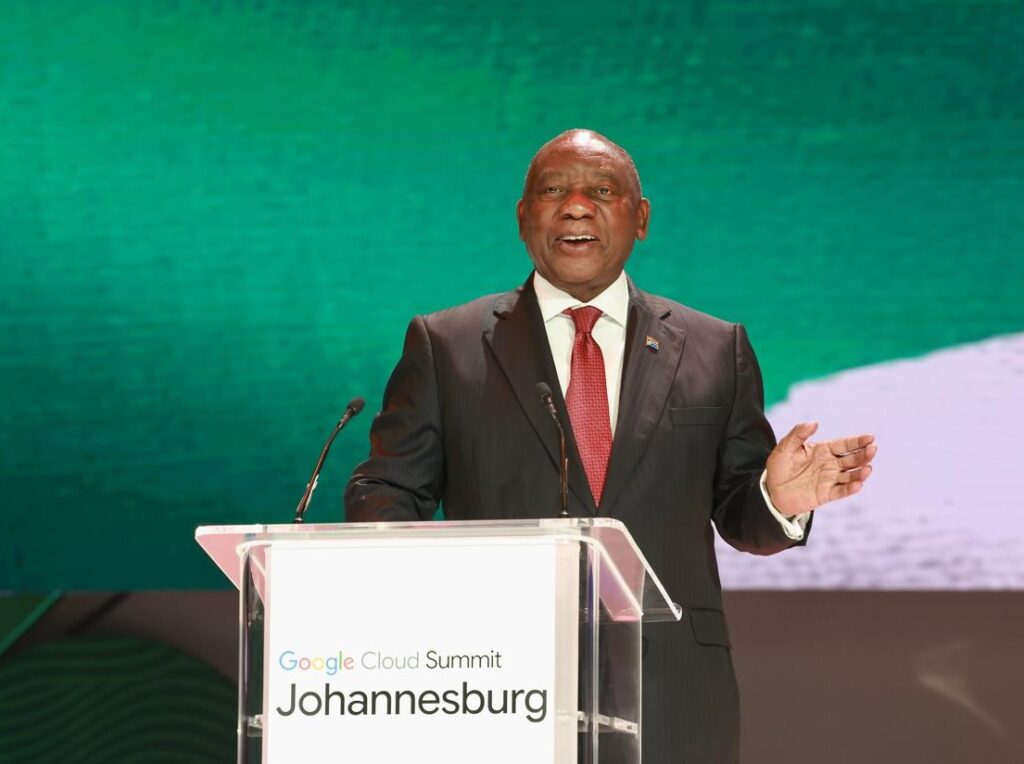
President Cyril Ramaphosa has called for Africa to take a leading role in the global shift towards artificial intelligence and cloud computing. He said the continent must help shape the technologies driving the 21st century economy.
He was addressing the inaugural Google Cloud Summit at the Sandton International Convention Centre in Johannesburg today.
The President said the gathering represented more than a technology conference. He said it marked a defining moment in Africa’s economic direction.
“Today is about far more than a technology conference. It is about where Africa chooses to position itself in the defining technological revolution of our lifetime,” he said.
Ramaphosa said infrastructure revolutions had always driven major economic shifts in history.
“Railways powered the Industrial Revolution. Electricity powered the twentieth century. Cloud computing and artificial intelligence will power the economies of the twenty-first century,” he said.
He added that Africa intended to play an active role in that future.
“Africa intends not merely to participate in that future. We intend to help shape it,” he said.
The President described the summit as a milestone for the continent. He said it reflects Africa’s growing importance in the global digital economy.
He said Africa was no longer only a consumer of technology. It is increasingly a producer and innovator of digital solutions.
“A substantial part of the projected global cloud value sits in Africa, where the demand for cloud solutions and scalable AI is growing exponentially,” he said.
Citing a 2024 McKinsey report, he noted that cloud adoption among major African businesses is already comparable to, and in some cases ahead of, developed markets.
“A 2024 McKinsey report found that cloud adoption in major African businesses was on par with, and in some instances even ahead of, adoption rates in North America and China,” he said.
Ramaphosa said South Africa is well positioned to lead the continent’s digital transformation. He pointed to its financial systems, universities, engineering skills and legal framework.
“These are precisely the ingredients required for a thriving AI economy,” he said.
He said the country already hosts a significant share of Africa’s hyperscale data centre capacity. It also remains a key destination for technology investment.
The President also highlighted Cape Town’s ranking among Africa’s top startup ecosystems. He said investor confidence remains strong.
“This confidence is underpinned by the progress we are making in the structural reform of our network industries and transformation of our economy,” he said.
He pointed to Operation Vulindlela as a key driver of digital transformation. This includes efforts to build national digital public infrastructure.
“A critical part of the structural reforms being coordinated through Operation Vulindlela is the creation of a comprehensive digital public infrastructure for South Africa that will serve as the backbone of our modern economy,” he said.
Ramaphosa said artificial intelligence is a general-purpose technology. He said it is comparable to electricity and the internet. It has the potential to reshape every sector.
“AI is not simply another technological innovation. It is a general-purpose technology comparable to electricity, the internet and the steam engine,” he said.
He said governments that prepare early will shape future prosperity.
He outlined a vision of widespread AI and cloud adoption across both public and private sectors. This includes healthcare, education, agriculture and energy systems.
He also stressed the need for skills development to ensure inclusive growth.
“We cannot allow digital poverty to widen the gap between the haves and the have-nots,” he said.
Ramaphosa welcomed Google’s investment in digital skills programmes. He said it would help build a generation of creators rather than consumers of technology.
“This will ensure that South Africans are not mere consumers of technology, but active creators and innovators,” he said.
He said Africa’s long-term strength lies in its people rather than its natural resources.
“Our predecessors built roads, ports, dams and power stations. Ours is the generation called upon to build the digital infrastructure that will power the African century,” he said.
He called for continued collaboration between government, business and technology partners.
“Let future generations say that when the opportunity came, Africa chose ambition over hesitation, innovation over imitation and partnership over isolation,” Ramaphosa said.