Yasmin Bilal
President Cyril Ramaphosa has challenged Southern African leaders to move beyond declarations and accelerate economic integration, industrialisation and development across the region.
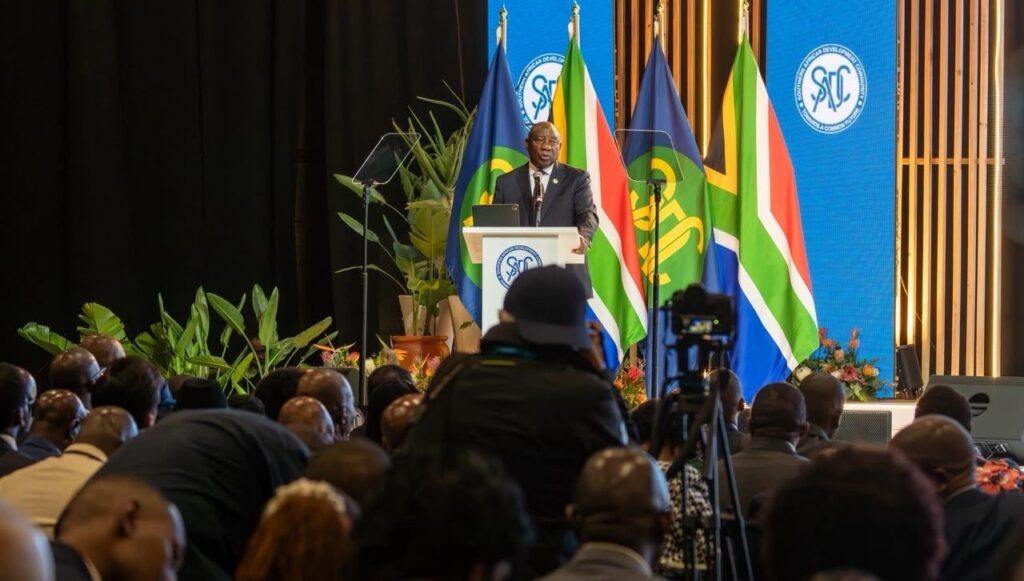
Addressing the 46th Ordinary Summit of SADC Heads of State and Government in eThekwini today, Ramaphosa said regional integration must deliver tangible benefits for ordinary people.
He said SADC had to turn its economic potential into jobs, industries, infrastructure and opportunities.
“We gather at this Summit to give practical meaning to its promise: to transform borders into bridges, national economies into a shared market, and geographical proximity into shared prosperity,” Ramaphosa said.
The summit is taking place in a city with a significant place in the history of African unity.
Ramaphosa pointed out that Durban hosted the launch of the African Union 24 years ago. The gathering also coincides with the anniversary of the signing of the SADC Declaration and Treaty in Windhoek, Namibia, on 17 August 1992.
“We therefore meet at the confluence of two defining moments in Africa’s history: the establishment of our Southern African Community and the birth of our continental Union,” he said.
Ramaphosa said these milestones should prompt leaders to reflect on whether they were moving quickly enough to realise the vision of those who came before them.
“The African Union was born out of the conviction that Africa’s future would be secured through cooperation, integration and unity,” he said.
He also paid tribute to Zimbabwean President Emmerson Mnangagwa, the outgoing SADC chairperson, thanking him for his leadership.
Ramaphosa also acknowledged Zambia, the SADC Troika, the Secretariat and member states for their contribution to the regional body.
He described SADC as an organisation built on solidarity.
“The story of SADC is a story of the triumph of solidarity over division and adversity,” Ramaphosa said.
“Before we became a development community, we were a community of solidarity.”
He said the region had overcome colonial rule and apartheid. The next challenge was to translate political liberation into economic and social progress.
SADC now comprises 16 countries and more than 400 million people.
Ramaphosa highlighted the region’s mineral resources, agricultural potential, youthful population and growing industrial and technological capabilities.
He also pointed to progress made through initiatives such as the SADC Free Trade Area, the SADC Real-Time Gross Settlement System and the Southern African Power Pool.
But he warned that regional integration was still moving too slowly.
“Our region recorded economic growth of approximately 3.4 per cent in 2025,” Ramaphosa said.
“Yet intra-SADC trade accounted for only around one-fifth of the region’s total trade.”
He criticised the continued reliance on imports and the export of raw materials.
“We continue to import too many goods that we could produce within our region,” he said.
“We continue to export raw materials that we could process and beneficiate ourselves.”
Ramaphosa said the region had the resources and people needed to build stronger economies.
“We have everything we need across the 16 Member States of our Community to meet the needs of our people,” he said.
“We have the natural resources. We have the land and agricultural potential. We have the skills and capabilities.”
He said more than 400 million people should be at the heart of the region’s development.
“Above all, we have more than 400 million people whose energy, ingenuity and enterprise must become the driving force of our development,” Ramaphosa said.
He said people wanted to see the benefits of economic liberation in their daily lives.
They were looking for decent jobs, reliable electricity, affordable food, quality healthcare and education. Young people also needed greater access to opportunities.
“They expect regional integration to improve their daily lives in visible, practical and meaningful ways,” he said.
Ramaphosa called for faster implementation of the Regional Indicative Strategic Development Plan 2020 to 2030.
Industrialisation was among his key priorities.
“The minerals and agricultural commodities of our region must become the foundation of Southern African manufacturing,” he said.
He called for greater processing of minerals and agricultural products, as well as increased manufacturing within the region.
Infrastructure was another major priority.
Ramaphosa called for investment in roads, railways and ports that connect countries and communities.
“Our infrastructure must connect not only capitals and commercial centres, but also rural communities, border towns and underserved regions that have remained on the margins of development,” he said.
He also called for stronger cooperation on electricity, water and digital connectivity.
The region needs to expand electricity generation and transmission capacity. Ramaphosa said cooperation through the Southern African Power Pool should be strengthened.
He also called for cross-border water infrastructure to support households, agriculture and industry.
Digital connectivity, he said, must be expanded so that young people and entrepreneurs can participate in the digital economy.
Food security was another priority.
Ramaphosa said the region had the potential to feed itself and become a major global food producer.
He called for greater agricultural productivity, stronger food reserves and better value chains. Smallholder and emerging farmers also needed more support.
The African Continental Free Trade Area was another opportunity for the region.
Ramaphosa said SADC businesses could use the agreement to access a continental market of more than 1.4 billion people.
But he said trade barriers had to be removed.
Border management needed to improve. Standards also needed to be harmonised.
“We must remove non-tariff barriers, improve border management, harmonise standards and make it easier for goods, services, capital and skills to move across our region,” Ramaphosa said.
He was particularly firm on implementation.
“Our decisions must be implemented,” he said.
“They must be properly costed, funded, assigned and monitored.”
Ramaphosa said SADC communiqués should translate into projects and opportunities.
“Our communiqués must become construction sites, factories, power lines, water systems, laboratories, businesses and jobs,” he said.
“Regional integration must be seen and felt in the daily lives of our people.”
He also warned that economic development could not be separated from peace and political stability.
“Peace without development is fragile. Development without peace is impossible,” Ramaphosa said.
He called for continued investment in preventive diplomacy, mediation and political dialogue.
He said differences should be resolved through dialogue, while member states must uphold shared democratic principles.
Ramaphosa compared SADC to a river system, with each country contributing its own strength while benefiting from collective action.
“Our Community is like a great river system,” he said.
“Each Member State is a tributary, with its own history, identity, character and strength.”
He said regional integration should strengthen rather than diminish individual countries.
“A tributary does not lose its identity when it joins a great river. It gains reach, depth and power,” Ramaphosa said.
“In the same way, regional integration does not diminish our sovereignty. It multiplies our collective capacity to secure the well-being of our people.”
He called for SADC to become stronger and better equipped to advance the region’s common interests.
Ramaphosa urged leaders to ensure the eThekwini summit was remembered for action rather than simply the declarations adopted.
“Let us turn our borders into bridges. Let us turn our resources into industries,” he said.
“Let us turn our youthful population into a powerful demographic dividend. Let us turn our solidarity into shared prosperity.”
He said the summit should reinforce the region’s commitment to peace, security and democracy.
It should also advance the development of diversified, industrialised and resilient economies.
Ramaphosa then declared the 46th Ordinary Summit of Heads of State and Government of SADC officially open.