Yasmin Bilal
The newly established National Council on Gender-Based Violence and Femicide has begun its work, with Government outlining its priorities for tackling the country’s GBVF crisis.
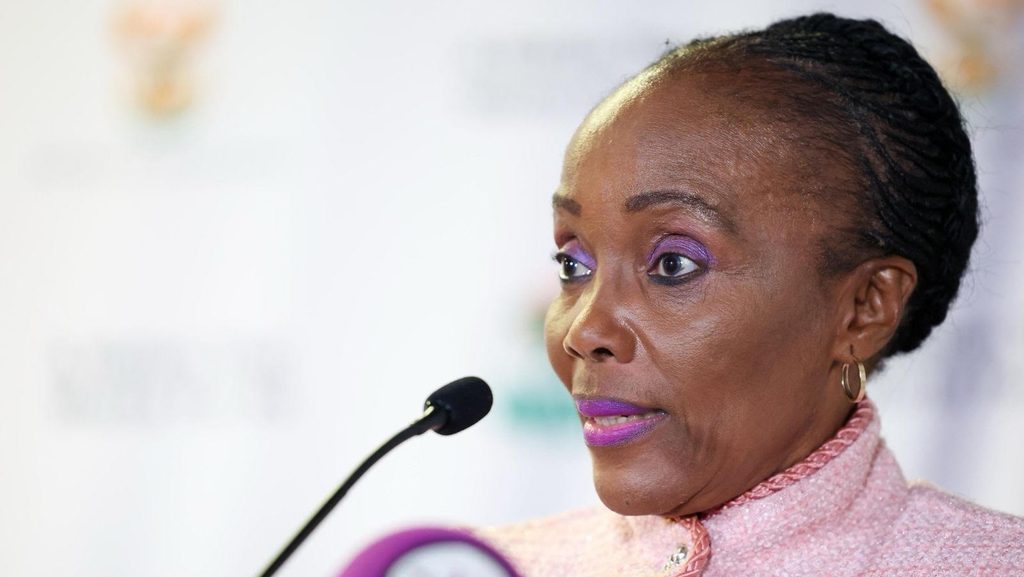
Minister in the Presidency for Women, Youth and Persons with Disabilities Sindisiwe Chikunga said the Council’s inaugural meeting on Monday marked a major step towards establishing a coordinated national response.
“By convening this morning, we have effectively set the long overdue ball rolling,” Chikunga said.
The Council was established under the National Council on Gender-Based Violence and Femicide Act 9 of 2024.
Its creation follows years of advocacy by survivors, women’s rights groups, civil society, faith communities, labour, traditional leaders, business and Government.
Chikunga said the Council’s modern origins can be traced to the First Presidential Summit Against Gender-Based Violence and Femicide in November 2018.
The National Strategic Plan on GBVF 2020 to 2030 later called for a permanent and coordinated mechanism to drive the national response.
The Council includes representatives from Government, women’s rights organisations, survivor advocacy groups, community-based organisations, faith-based organisations, disability rights groups, youth formations and LGBTQIA+ advocacy structures.
Research and academic institutions, traditional and community leaders, business, labour and development partners are also represented.
Chikunga stressed that the Council’s role goes beyond sectoral representation.
“The duty of the Council is to the Constitution, the Act, to women, girl children, survivors of GBVF and to the people of South Africa,” Chikunga said.
The Council will coordinate the national multisectoral response to GBVF. It will also monitor implementation of the National Strategic Plan, advise Government on policy and legislative reforms and promote accountability.
Other responsibilities include commissioning research, monitoring national targets, mobilising resources, strengthening prevention programmes and supporting survivor-centred interventions.
Chikunga said the Council begins its work against a backdrop of extensive evidence on the scale of violence in South Africa.
The Human Sciences Research Council’s first national Gender-Based Violence Prevalence Study, released in November 2024, found that about 7.3 million women aged 18 and older had experienced physical violence during their lifetime.
More than 2.15 million women had experienced sexual violence.
The study also found that about 3.2 million women had experienced physical intimate partner violence. About 2.5 million men admitted to perpetrating physical intimate partner violence.
Women with disabilities face an even greater risk.
The study found that lifetime sexual violence by a partner was twice as high among women with disabilities as among women without disabilities. The figures were 14.6% and 7.2% respectively.
Chikunga also referred to the latest SAPS crime statistics for the first quarter of the 2026/27 financial year, covering April to June.
A total of 50,511 GBVF cases were registered. Of these, 30,736 resulted in arrests or referrals to the National Prosecuting Authority.
“These are not just statistics. These are South African women, daughters, sisters and girl children,” Chikunga said.
The Council has identified several immediate priorities.
One is the conclusion of a Shareholder Compact between Government and the Council. The compact will set out expectations and provide a framework for measuring performance.
The Council will also develop a comprehensive costing framework for the national response to GBVF.
Chikunga said the Council must determine what resources are needed to tackle the crisis effectively. It will identify gaps and develop a national investment case.
Good governance and fiduciary responsibility have also been identified as priorities.
Chikunga said the Council must become a model of ethical, accountable and transparent governance.
She described the establishment of the Council as part of a broader constitutional commitment to equality, dignity and freedom.
“The Council belongs not only to government, but to the nation,” Chikunga said.
Chikunga said its success would depend on continued cooperation between Government, civil society, labour, business, faith communities, traditional leaders and the public.
“The responsibility now rests with the National Council to fulfil its mission to help transform the rights contained in the Bill of Rights into lived realities for every woman and girl child in the Republic of South Africa,” Chikunga said.