Yasmin Bilal
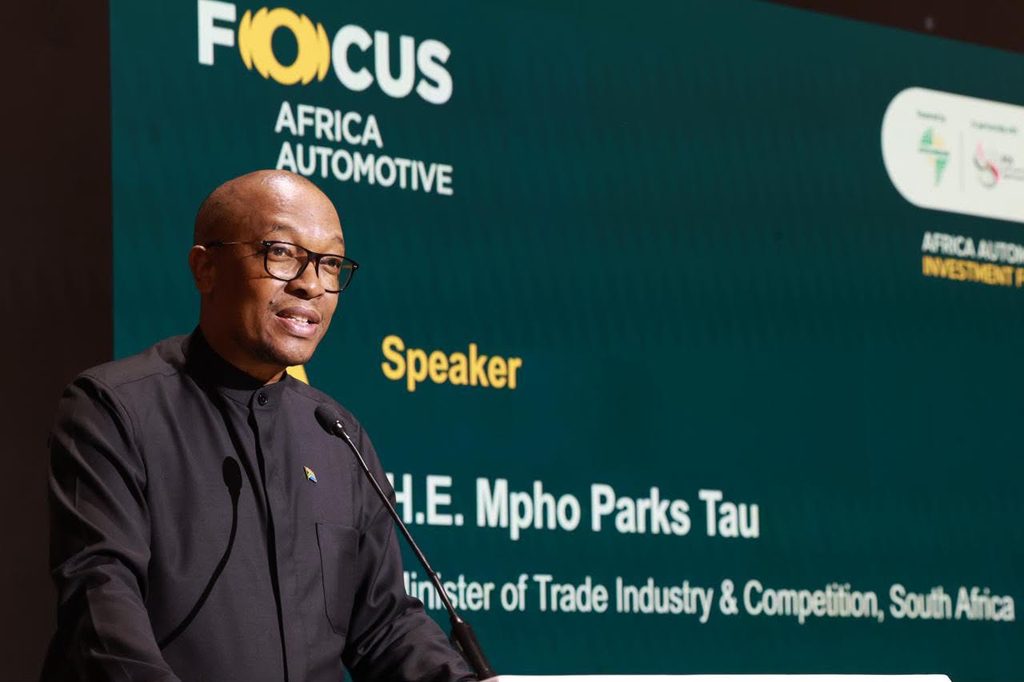
Trade and Industry Minister Parks Tau wants African countries to work more closely to grow the continent’s automotive industry and attract investment into manufacturing.
Tau was speaking at the Africa Automotive Investment Forum hosted by Afreximbank at the Rixos Hotel Alamein in Egypt today.
He said governments, financiers, vehicle manufacturers, suppliers and investors needed to work together to turn plans for the sector into projects that could attract funding.
“Collaboration remains the important ingredient to grow the automotive sector in Africa. We must use this forum to move from ambition to implementation,” Tau said.
He said this should include connecting African companies to regional value chains and processing critical minerals on the continent. It should also involve increasing investment in automotive manufacturing.
“Our task is to crowd in capital, deploy project-preparation capacity, strengthen intra-African trade infrastructure, make greater use of AfCFTA instruments, and ensure that continental integration supports real factories, real suppliers, real jobs and real exports,” he said.
Africa currently accounts for a small portion of global vehicle production.
The continent produced about 1.23 million vehicles, compared with approximately 96.4 million vehicles globally. This represented about 1.3% of worldwide production.
South Africa produced approximately 618,077 vehicles in 2025, while Morocco announced in December that its production had reached one million vehicles.
Together, South Africa and Morocco accounted for more than 91% of Africa’s vehicle production.
Tau said the AfCFTA Automotive Fund, supported by Afreximbank’s US$1 billion facility for local content development, was part of efforts to expand the sector.
The longer-term continental target is to produce between four million and five million vehicles in Africa by 2035, including new energy vehicles and components.
Tau also put forward the idea of an automotive pact between the Southern African Customs Union and Egypt.
He said closer cooperation could create economies of scale and increase trade in vehicles and components. It could also help African countries develop complementary production rather than duplicating small-scale manufacturing.
The proposed pact would cover industrial and investment cooperation, regulatory and administrative matters, as well as trade and value chains.
Areas under consideration include vehicle assembly, component manufacturing, batteries, electric mobility, localisation, technology transfer and skills.
The regulatory component could address standards, conformity assessment, homologation, customs procedures and trade in original equipment and components.
Trade measures could include preferential market access, treatment of completely built-up and knocked-down vehicles and components, rebates, duty-credit arrangements and recognition of value addition.
Tau said the proposal came as African economies faced greater protectionism, supply-chain vulnerabilities and uncertainty over access to traditional markets.
South Africa is seeking investment across its automotive value chain, including passenger vehicles, light commercial vehicles, buses and trucks.
Tau also highlighted opportunities in tier-one, tier-two and tier-three components, tooling, moulds, dies, precision engineering, electronics, software, telematics and mobility services.
Other areas include testing and homologation, logistics, ports, rail, roads, industrial parks, research, skills development and technology transfer.
He identified tyres, glass, seating systems, wiring harnesses, catalytic converters, drivetrain components, body panels, plastics and advanced materials as potential areas for greater localisation.
Tau said South Africa’s Automotive Master Plan 2035, Automotive Production Development Programme and the AfCFTA framework were intended to provide investors with policy certainty.
The frameworks also support production, supplier development and exports.
He said South African companies were positioned to invest elsewhere in Africa in vehicle assembly, components, dealerships, after-sales services, logistics, charging infrastructure, battery value chains, industrial parks and supplier partnerships.
Egypt, he said, was an important potential partner because of its industrial base, domestic market and position linking Africa with the Middle East and Europe.
The country’s Automotive Industrial Development Programme, introduced in 2022, includes measures to localise production, support feeder industries, develop electric vehicle-related industries and attract investment.
Tau said South Africa was also preparing for the global shift towards electric, hybrid and hydrogen-enabled vehicles.
The country’s 2023 Electric Vehicle White Paper supports the transition and identifies areas including electric vehicle assembly, battery mineral processing, battery precursor materials, cell and pack manufacturing, charging infrastructure, power electronics, recycling and second-life battery applications.
Africa has deposits of minerals needed for these industries, including platinum group metals, manganese, nickel, cobalt, copper, lithium, graphite, iron and rare earth elements.
“The strategic imperative is clear: Africa must beneficiate these endowments on the continent and convert mineral wealth into manufactured products, skilled jobs and export earnings,” Tau said.
Tau cited International Energy Agency figures showing electric car sales exceeded 20 million in 2025, representing about one in four new cars sold.
Global electric vehicle production reached 17.3 million units in 2024, with more than 70% produced in China.
He said electric vehicles accounted for about 5% of the global car stock and displaced about 1.2 million barrels of oil a day. Sales are projected to reach 55 million by 2035.
Tau said the figures highlighted the need for Africa to develop its own capacity in electric vehicle assembly, battery beneficiation, components, charging infrastructure, grid readiness and skills.