Yasmin Bilal
The African National Congress has reaffirmed its support for government’s programme to repatriate the remains of former Umkhonto weSizwe (MK) combatants who died in exile in Angola.
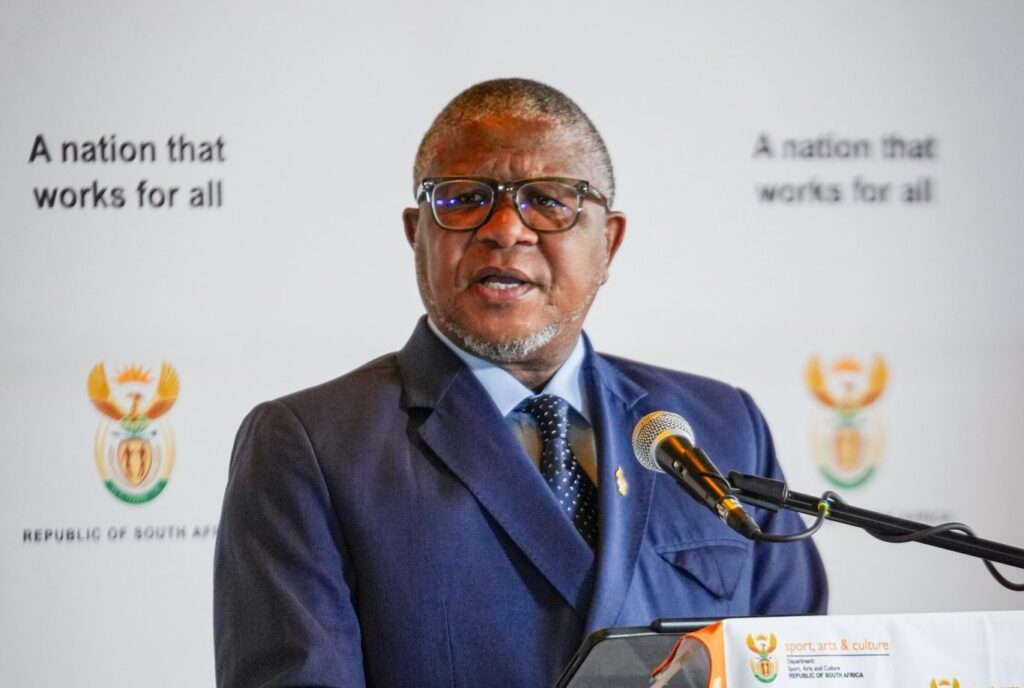
ANC Secretary General Fikile Mbalula, accompanied by acting national spokesperson Nonceba Mhlauli, attended a government media briefing at Freedom Park today. Government provided an update on the Angola repatriation process.
The programme follows the Memorandum of Understanding signed between the governments of South Africa and Angola in December 2024. The agreement falls under the Roads to Independence: African Liberation Heritage Programme. It also forms the second phase of government’s Repatriation and Restitution of Human Remains and Heritage Objects Plan.
Mbalula said the project aimed to return the remains of liberation fighters who never made it home. He said families had been involved throughout the process.
“This programme gives effect to the Memorandum of Understanding signed between the governments of South Africa and Angola in December 2024 under the Roads to Independence: African Liberation Heritage Programme,” Mbalula said.
“We are deeply honoured to be part of this historic collaboration in the implementation of the Roads to Independence: African Liberation Heritage Programme in Angola. This project is integral to our programme to repatriate the mortal remains of our combatants who died in exile, and lay them to rest at home amongst their people and their ancestors,” he said.
“We have been through a painstaking process, working closely with families to bring home our fallen heroes,” said Mbalula.
He said the programme reflected government’s commitment to honouring those who sacrificed their lives during the liberation struggle.
“None of this is the end of the journey, and we do not pretend that unemployment, inequality and poverty have been defeated. But it is the clearest demonstration of our commitment to make the promise of a better life for all a lived reality, honouring the sacrifice of our comrades in Angola’s camps and battlefields,” he said.
Mbalula said the ANC remained committed to the National Democratic Revolution.
“The ANC’s mission has never been about a mere change of flag and a seat in Parliament. Our movement remains committed to the National Democratic Revolution: the building of a non-racial, non-sexist, united and prosperous society in which political freedom is matched by economic freedom,” he said.
He said this included accelerating land reform and deepening industrialisation and localisation. It also meant transforming ownership patterns in the economy and ensuring economic growth translated into jobs for young South Africans.

Reflecting on the liberation struggle, Mbalula said the ANC turned to armed resistance after it was banned in 1960. He said peaceful avenues of resistance had been closed.
Thousands of young South Africans left the country for exile. Many had taken part in the 1976 Soweto uprising. They crossed into neighbouring countries to continue the struggle against apartheid.
Angola became one of the movement’s most important bases after gaining independence from Portuguese colonial rule in 1975, Mbalula said.
“It was in Angola, following that country’s own hard-won independence from Portuguese colonialism in 1975, that Umkhonto weSizwe found the ground on which to train and to organise,” he said.
Mbalula said Novo Catengue became the movement’s military and political training base. Known by MK cadres as the “University of the South”, it was bombed by the apartheid air force in 1979.
“Our combatants moved further into Angola and continued, undeterred, to prepare for the day South Africa would be free,” he said.
He said many freedom fighters never lived to see democracy.
“Not all of them lived to see that day. Some fell in confrontations with apartheid’s proxy forces. Some were lost to disease, to the sheer brutality of exile, far from the mothers and fathers who had no way of knowing what had become of their children,” Mbalula said.
He said many families had spent decades without knowing what had happened to their loved ones.
“For decades, too many families in KwaZulu-Natal, in the Eastern Cape, in Limpopo and beyond have lived without a grave to visit and without an answer to the simplest of questions: what happened to our child? Today’s programme seeks to answer that question, wherever the truth can still be found,” he said.
Mbalula also praised Angola for supporting South Africa’s liberation struggle despite facing its own conflict.
“The people of Angola did not merely host our combatants. They shared their independence with us before their own state had even finished securing it,” he said.
He said MK combatants fought alongside Angolan forces and Cuba’s internationalist contingent. The Battle of Cuito Cuanavale, fought between 1987 and 1988, became a defining moment in Southern Africa’s liberation struggle, Mbalula said.
“It is not an exaggeration to say that the road from Cuito Cuanavale led, in a straight line, to the unbanning of our movement in 1990 and to the first democratic elections in 1994. We owe that outcome to the blood of Angolans, Cubans and South Africans mixed on the same soil, and it is a debt the ANC does not forget,” he said.
Mbalula said the repatriation programme was also about giving families long-awaited answers.
“To the families gathered here, and to those still waiting at home for news of a parent, a sibling, a child: the African National Congress stands with you, as it has stood with the people of Angola since the 1970s. We will not rest until every story that can be told is told, and every combatant who can be brought home is brought home,” he said.
He urged families who lost relatives in Angola to come forward and assist with the identification process.
“We do not pretend that this work is simple. Our recovery teams must contend with minefields, with unmarked graves, and with a landscape reshaped by nearly three decades that have passed since the wars in Angola ended,” Mbalula said.
“We appeal today to every family who lost a relative in Angola during those years to come forward through the platforms government has put in place. Nothing in this process can proceed without you,” he said.
Mbalula said South Africa had made significant progress since democracy. Apartheid laws had been replaced by constitutional rights, he said. Access to housing, water, electricity, education and healthcare had also expanded, while social grants now reached more than 18 million people every month.
He said the ANC would continue supporting the repatriation programme so that former MK combatants who could be brought home would finally be laid to rest with dignity.