Yasmin Bilal
BRICS has reaffirmed its support for the Palestinian people. It is calling for the implementation of relevant UN resolutions, unhindered humanitarian access to Gaza and an end to policies aimed at forcibly displacing Palestinians.
The position was set out in the New Delhi Declaration adopted at the 18th BRICS Leaders’ Summit in India. Leaders also expressed deep concern over continued violence in Gaza despite the ceasefire agreement reached in October 2025.
The declaration opposes the temporary or permanent forced displacement of Palestinians from the Occupied Palestinian Territory. It reaffirms the Palestinian people’s right to self-determination and return.
BRICS also supports the State of Palestine’s full membership in the United Nations. It backs the establishment of a sovereign, independent and viable Palestinian state based on the internationally recognised 1967 borders, with East Jerusalem as its capital.
The bloc condemned attacks against civilians and civilian infrastructure, including healthcare facilities. It also rejected the use of starvation as a method of warfare and the unlawful obstruction of humanitarian assistance.
It reaffirmed its support for the United Nations Relief and Works Agency for Palestine Refugees in the Near East. The declaration also noted the provisional measures issued by the International Court of Justice in South Africa’s proceedings against Israel.
BRICS further rejected unilateral measures aimed at changing the legal or historical status of occupied Jerusalem.
BRICS also addressed the wider Middle East, welcoming the ceasefire in Lebanon and calling for compliance with United Nations Security Council Resolution 1701. It called for the safety and freedom of movement of UN peacekeepers serving with the United Nations Interim Force in Lebanon.
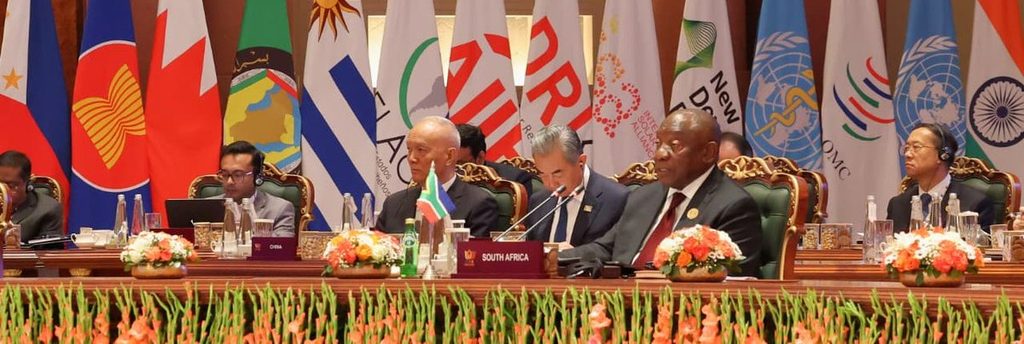
President Cyril Ramaphosa was among the leaders attending the summit, hosted by India under its 2026 BRICS chairship.
Ramaphosa participated in a closed session on inclusive global governance and strengthening multilateralism. Discussions covered global governance, economic cooperation, sustainable development, peace and security, and the future of the BRICS partnership.
Beyond the Middle East, the declaration sets out a broad agenda covering reform of global institutions, trade, development finance, artificial intelligence, health, climate change, biodiversity, education, labour and the role of women.
BRICS called for reform of the United Nations and its Security Council to make the system more representative, democratic, effective and responsive to the interests of developing countries.
The bloc also backed reforms to the International Monetary Fund and World Bank. It said the institutions should better reflect the growing role of emerging markets and developing economies.
On trade, BRICS voiced concern over unilateral tariffs and non-tariff measures that threaten global trade, disrupt supply chains and create uncertainty.
It reaffirmed support for an open, fair, transparent and predictable multilateral trading system based on World Trade Organisation rules.
The declaration also supports greater use of local currencies and improved cross-border payment systems. The aim is to make international transactions faster, safer and less costly, while recognising that countries may follow different approaches.
Artificial intelligence featured prominently in the declaration. BRICS described the technology as an opportunity for economic growth and sustainable development while calling for international cooperation on safety, security, accessibility, inclusiveness and responsible AI governance.
Leaders also highlighted growing risks linked to cybercrime, malicious software, deepfakes, misinformation and disinformation. They supported greater cooperation on cybersecurity and digital development.
On health, BRICS committed to stronger cooperation on universal health coverage, disease prevention, mental health, health workforce development and preparedness for future health emergencies.
Obesity and non-communicable diseases were identified as major public health challenges.
Climate change and environmental protection also formed part of the agenda. The declaration reaffirmed commitments under the Paris Agreement and highlighted the need for greater climate finance for developing countries.
BRICS also addressed biodiversity, forests, water security, drought, desertification, land degradation and wildfire. Leaders encouraged cooperation on conservation and sustainable development.
The declaration supports a growing role for the New Development Bank in financing infrastructure, innovation and development across BRICS countries and the wider Global South.
Women, young people, education and employment also feature prominently. Leaders called for greater participation of women in decision-making, stronger digital and financial inclusion, skills development and improved access to education and employment opportunities.
The New Delhi Declaration marks 20 years of BRICS cooperation and sets out priorities for the bloc as it seeks to strengthen its influence in global economic and political affairs.