Yasmin Bilal
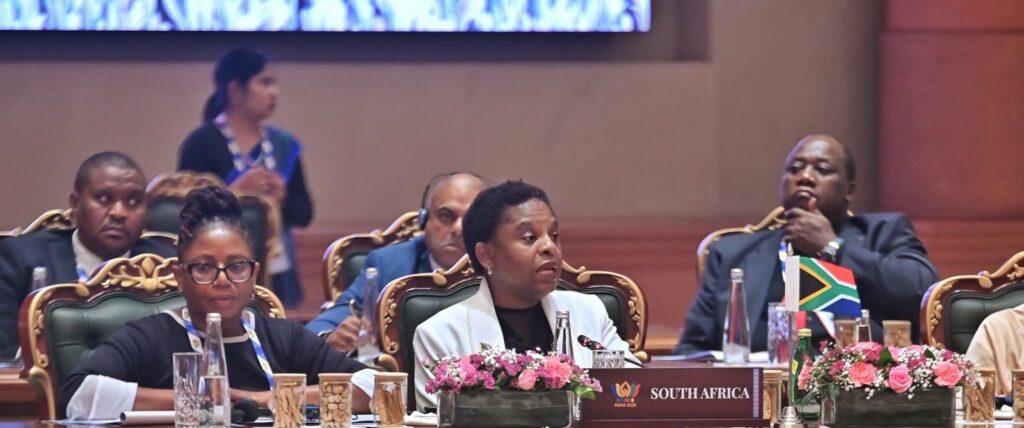
Global instability, climate shocks and fast-moving technological change are deepening risks across the world. South Africa’s Minister in the Presidency, Khumbudzo Ntshavheni, raised the concern at a BRICS meeting in Delhi, India.
She addressed the 16th BRICS Meeting of High-Ranking Officials Responsible for Security Matters. The session focused on non-traditional challenges in an uncertain global environment.
Ntshavheni said the world is changing at a speed that is difficult to manage. The scale of change, she warned, is already affecting vulnerable communities.
“We are meeting when the global environment is changing at a pace and scale that we could not have imagined, with dire consequences for the security of our people,” she said.
Rising geopolitical tensions were highlighted, along with emerging conflicts and disrupted supply chains. Technology, she noted, is advancing faster than regulation in many parts of the world.
This creates both opportunity and risk, especially where governance frameworks lag behind innovation.
Climate change was flagged as a growing driver of instability. The world, she said, has not done enough to use technology to reduce its impact.
BRICS countries, she said, have a responsibility to protect vulnerable populations from these shifts.
“BRICS countries have the responsibility to ensure that this unmediated change does not come at the expense of the most vulnerable,” she said.
Global health threats formed another key focus. COVID-19, Ebola outbreaks in Africa and other infectious diseases were cited as examples.
Health emergencies, she said, can destabilise countries quickly and reverse years of development progress.
South Africa is investing in disease surveillance systems and supporting the Africa Centres for Disease Control and Prevention. Vaccine research and manufacturing capacity is also being expanded across the continent.
Stronger coordination among BRICS members on disease outbreaks was called for. The minister also discouraged blanket travel bans during health crises.
Extreme weather events such as droughts, floods and storms are becoming more frequent. These events damage infrastructure, destroy crops and displace communities.
“These events do not only affect statistics; they affect real lives,” she said.
Climate pressures, she stressed, are directly linked to food systems. Food insecurity can, in turn, trigger wider instability.
Efforts are underway to strengthen smallholder farming and improve storage and distribution systems. Regional cooperation is also being expanded to build more resilient food networks.
Climate change, pandemics and technological risks were described as interconnected challenges requiring coordinated responses.
South Africa’s just transition policy was outlined as an approach that balances emissions reduction with the protection of workers and communities.
“A transition which deepens poverty or widens inequality will undermine national stability,” she said.
BRICS remains a key platform for cooperation among developing economies. It can support reform of global governance systems and deepen collaboration on shared challenges.
Areas of cooperation include climate finance, food systems, outbreak response and green technology.
Africa’s development priorities, including the African Continental Free Trade Area and Agenda 2063, were emphasised as central.
Global instability is worsened when responses are fragmented and inconsistent.
“For South Africa, the real danger is in a disorderly transition in which power is used selectively and shared threats are met with fragmented responses,” she said.
Reform of global institutions such as the United Nations Security Council and the World Trade Organisation was also called for, including stronger African representation.
She called for stronger BRICS cooperation to build a more stable and inclusive global system.