News Desk Reporter
A R30.3 billion profit has strengthened the power utility’s financial position, marking its second consecutive profitable financial year.
The result for the year ended 31 March 2026 is more than double the restated R14 billion profit recorded in 2025.
The utility’s EBITDA margin also increased to 30.63%, compared with 28.75% in the previous financial year.
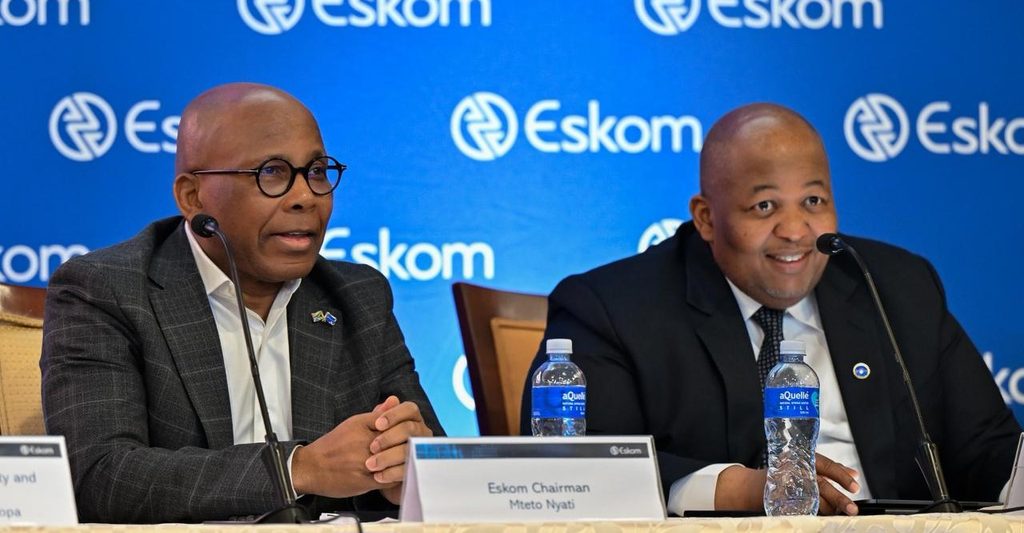
Eskom chairperson Mteto Nyati said the stronger results reflected improvements in operations and tighter control of costs.
He said the improved financial position would allow the utility to put more money back into its operations, including grid expansion, distribution and improving the reliability of its coal-fired power stations.
“This is the second consecutive year that Eskom has delivered a profit. That performance was earned through operational recovery and cost discipline,” Nyati said.
The improved financial performance comes as electricity supply has also stabilised. The utility has now gone more than a year without load shedding.
Group Chief Financial Officer Calib Cassim said the operational recovery was supported by a healthier balance sheet and improved liquidity.
The utility has also received positive credit-rating actions from S&P Global, Fitch and Moody’s. It secured its first credit-rating upgrade in more than a decade.
Cassim said the improved rating should help the utility access funding at lower borrowing costs. This will support future capital expenditure.
He said government’s debt relief programme had also played an important role by allowing more cash generated through operations to be directed back into the business rather than towards debt servicing.
One of the main areas benefiting from the additional financial capacity is the generation recovery plan.
Group Chief Executive Dan Marokane said the utility was now looking beyond stabilising its finances and operations.
He said it was moving towards becoming a more competitive and financially sustainable organisation capable of supporting the country’s future energy needs.
“Sustained profitability, significant progress in our audit recovery program aimed at strengthening internal controls, and improved efficiencies enable Eskom to continue to address electricity affordability with our shareholder,” Marokane said.
The utility wants to keep electricity price increases within single digits while continuing to invest in its infrastructure.
Marokane said profits would also be used to maintain and expand critical infrastructure. The utility also plans to introduce technologies needed for its transition towards lower-carbon energy.
The recovery is significant for the wider economy.
The Council for Scientific and Industrial Research estimated that load shedding cost the South African economy as much as R2.8 trillion in 2023.
That figure fell by 83% to R481 billion in 2024.
During the 2026 financial year, there were four days of load shedding, amounting to 26 hours in total. Marokane said the resulting impact on the economy was minimal.
He also pointed to the wider consequences of the utility’s financial position. A struggling power utility places pressure on the national budget and can affect the country’s credit rating and borrowing costs.
A financially stronger utility can instead support economic reforms by providing the reliable electricity supply needed to attract investment and new competitors.
It can also help accommodate more renewable energy on the national grid.
Marokane said this transition would require the utility to maintain its 24-hour electricity supply while the country develops new energy technologies and generation capacity.
The latest results come as the power utility seeks to build on its operational recovery while preparing for a changing energy market.