Noko Mashilo
Just two years after travelling to China to sharpen her mushroom production skills, Charity Nomcebo Nkalanga is expanding her agricultural knowledge in Brazil.
The 32-year-old teacher from Kamhlushwa village in Mpumalanga’s Nkomazi Municipality is attending an international programme focused on climate-smart agriculture, sustainable food systems and agroforestry.
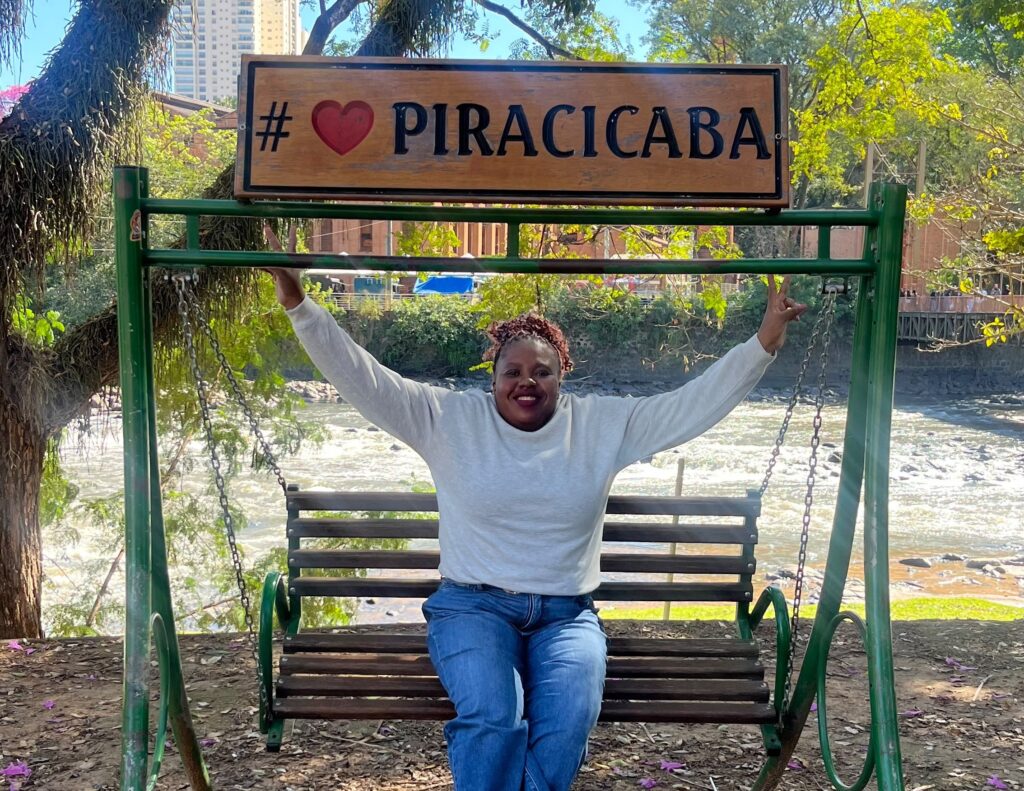
Nkalanga, who teaches at Njeyeza Secondary School and is an aspiring mushroom farmer, is taking part in the Areyeng Brazil International School Programme at the University of São Paulo in Piracicaba. The programme, which runs from 13 to 24 July, is sponsored by the National Youth Development Agency (NYDA) and focuses on tropical bio-based production systems.
Reflecting on her journey from China to Brazil, Nkalanga said the experience had broadened her perspective on agriculture.
“It feels like a dream and a responsibility at the same time. Going from China to Brazil now shows me that agriculture is truly global. Each country teaches me something new, and I’m proud that my journey is growing. It reminds me that young Africans belong in these international spaces and that we can learn, adapt, and bring solutions back home,” Nkalanga said.
She said the programme explores sustainable agroforestry, food and nutritional security, climate-smart agriculture, soil and water management in tropical regions, and the value addition of bio-based products.
As part of the programme, Nkalanga is working with participants from Brazil and Colombia on a project aimed at tackling deforestation in the Amazon. The initiative focuses on multi-strata agroforestry systems that mimic natural forests while producing food, creating income and restoring ecosystems.
Nkalanga said the NYDA-sponsored opportunity had opened new doors for her and highlighted the competitive selection process.
“This opportunity means everything to me. NYDA believed in young people and gave us a chance to represent South Africa internationally. The selection process was very competitive. We had to demonstrate our track record, our vision and how we plan to impact our communities. I’m grateful to NYDA for investing in youth and in agriculture as a future industry,” she said.
She said her experience in China had laid a strong foundation for her agricultural journey.
“In China I learned discipline, precision and the importance of controlled environments. The biggest lesson was that small-scale production can be very profitable if you focus on quality, hygiene and market linkages. I still apply that mindset of efficiency, record keeping and adding value to every product,” Nkalanga said.
Comparing the two countries, Nkalanga said China excelled in technology-driven intensive farming, while Brazil focused on working in harmony with nature.
“Brazil’s approach to sustainable farming is about agroforestry, biodiversity and using native species to restore land while producing food. It has shown me how to design farming systems that look like forests,” she said.
She believes South Africa could benefit from adopting multi-strata agroforestry systems, stingless bee farming and community cooperatives that process agricultural products collectively to improve farmers’ incomes.
Despite language barriers, cultural differences and being far from home, Nkalanga said every challenge had strengthened her determination.
“The biggest challenge is being away from home, but I keep reminding myself why I’m here to learn skills that will uplift my community. These experiences have taught me patience, respect and the importance of listening first,” Nkalanga said.
Her international exposure has also expanded her vision beyond mushroom production.
“Before I only saw mushrooms. Now I see entire food systems. I see how we can combine mushrooms with agroforestry, bees and processing to create resilient farms. International exposure showed me that I don’t have to choose one crop. I can build an integrated agribusiness that addresses food security, climate and jobs,” she said.
As an agricultural educator and a person living with a disability, Nkalanga said she was determined to ensure the knowledge she had gained would benefit others.
She plans to incorporate what she has learned into her classroom lessons, share it with fellow educators through conferences, and work with local farmers and cooperatives to promote sustainable farming practices.
“I hope my journey will inspire my learners and other young people that challenges are not barriers to success in agriculture,” Nkalanga said.
Looking ahead, Nkalanga hopes to establish a large mushroom enterprise producing edible and pharmaceutical mushrooms while creating employment opportunities for more than 100 young people, particularly women and people with disabilities.
She also plans to establish a centre of excellence where aspiring farmers can receive training in climate-smart, tropical and indigenous farming systems.
Encouraging young South Africans to consider agriculture, Nkalanga urged them to make use of the opportunities available to them.
“Don’t wait for big funding. Learn the market first, find mentors, apply for programmes like NYDA and farm with purpose. Solve a problem in your community,” she said.