Thokozile Mnguni
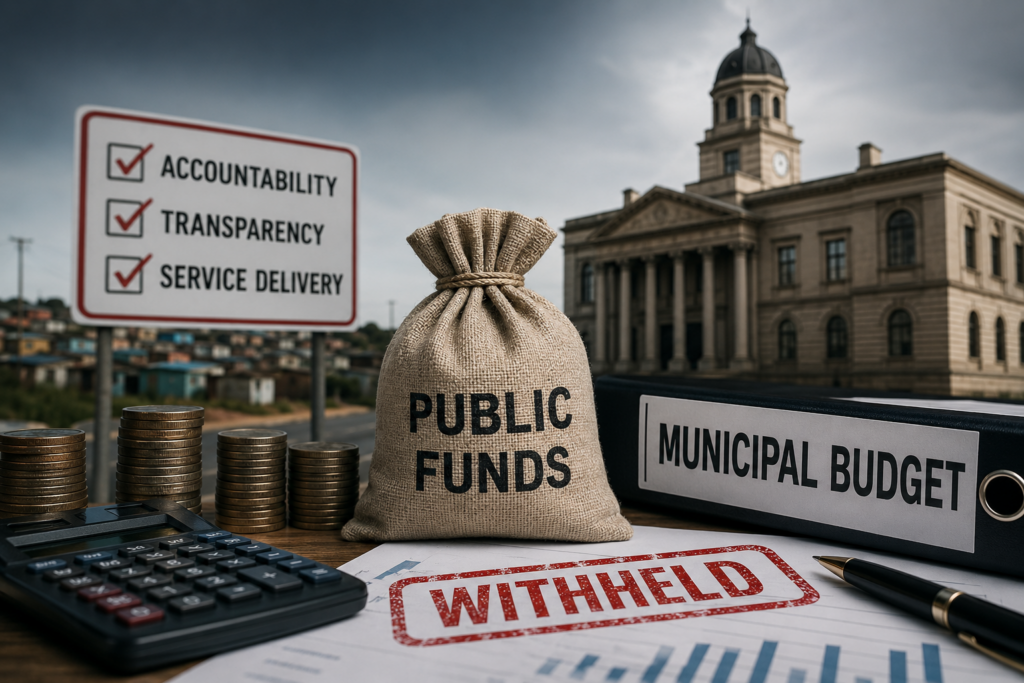
Several municipalities will have their equitable share funding withheld after repeatedly failing to comply with financial management laws.
National Treasury warned that continued poor governance is placing growing pressure on local government finances.
The affected municipalities failed to comply with the Municipal Finance Management Act (MFMA), despite receiving guidance, training and ongoing support to improve financial management.
According to Treasury, many municipalities have failed to adopt funded budgets. They have also failed to address unauthorised, irregular, fruitless and wasteful expenditure, and meet their statutory financial obligations.
Some municipalities have also failed to investigate financial misconduct, recover losses where appropriate, or hold officials and office bearers accountable.
Treasury stressed that the intervention is temporary and aimed at correcting financial shortcomings rather than punishing municipalities. It said the short-term withholding of funds is not expected to affect service delivery.
Before taking the decision, Treasury gave each municipality written notice and an opportunity to explain why its equitable share allocation should not be withheld.
Municipalities were also urged to take corrective action before the transfers were suspended.
Treasury said it has spent years supporting municipalities through training programmes, technical guidance, one-on-one engagements and compliance circulars.
Despite these efforts, many municipalities continue to fall short of the financial standards required by law.
The department warned that poor financial management is placing increasing pressure on bulk service providers such as Eskom and water boards.
Delayed payments are also affecting statutory institutions, including the Auditor-General of South Africa, the South African Revenue Service and the Financial Sector Conduct Authority.
Treasury said some municipalities have failed to properly investigate unauthorised, irregular, fruitless and wasteful expenditure.
Others have not referred these matters to their Municipal Public Accounts Committees, which oversee financial accountability.
In several municipalities, consequence management has also not been properly implemented.
Treasury said this includes delays in disciplinary action, investigations, the recovery of financial losses and criminal referrals where required.
The latest Auditor-General’s report supports Treasury’s concerns.
Since the 2021/22 financial year, municipalities have recorded R24.12 billion in fruitless and wasteful expenditure, R145.21 billion in irregular expenditure and R118.13 billion in unauthorised expenditure.
The report also found that municipal finances continue to deteriorate.
During the 2024/25 financial year, 116 municipalities adopted unfunded budgets. By year-end, municipalities owed R3.40 billion in interest to Eskom and R1.21 billion to water boards.
Forty-eight municipalities had also failed to pay third-party deductions within the required time.
Treasury said the withheld funds will be released once municipalities meet the required conditions.
They must also provide proof that the identified shortcomings have been addressed.
Treasury added that it will continue working with municipalities, provincial treasuries and cooperative governance structures to strengthen financial management across local government.
The South African Municipal Workers’ Union (SAMWU) strongly criticised the move, warning that it could deepen the financial challenges facing municipalities.
“This is not a corrective intervention but rather a recipe for deepening the municipal financial crisis,” the union said.
SAMWU also rejected Treasury’s assurance that services would not be affected.
“Municipalities cannot provide water, sanitation, electricity, refuse removal, or road maintenance without the financial resources necessary for daily operations,” it said.
The union argued that municipal workers should not be punished for financial failures they did not create.
It called for the immediate reversal of the decision and urged government to work with organised labour and municipalities on alternative solutions.
ActionSA welcomed Treasury’s intervention, saying stronger accountability was needed.
Gauteng Legislature Caucus Leader Funzi Ngobeni said: “This is not about punishing municipalities. It’s about restoring accountability.”
Ngobeni added that the intervention “marks an important shift from monitoring problems to enforcing compliance”.
He urged affected municipalities to act quickly, saying this would allow withheld funding to be released sooner.
The South African Local Government Association (SALGA) said the intervention highlights wider financial challenges facing municipalities.
While welcoming Treasury’s assurance that the process is corrective rather than punitive, the association said long-term solutions require more than enforcement.
SALGA said: “Municipal sustainability depends on payment for services.”
It called on residents, businesses, government departments and other consumers to settle outstanding municipal accounts.
The association warned that municipalities continue to face broader financial pressures.
These include growing debt, unfunded mandates, infrastructure backlogs and revenue constraints.
“Enforcement alone will not resolve municipal financial distress,” SALGA said.
SALGA added that it will continue working with National Treasury, the Auditor-General, the Department of Cooperative Governance, provincial governments and municipalities.
The aim is to strengthen governance, improve financial controls and support long-term financial sustainability.