Yasmin Bilal
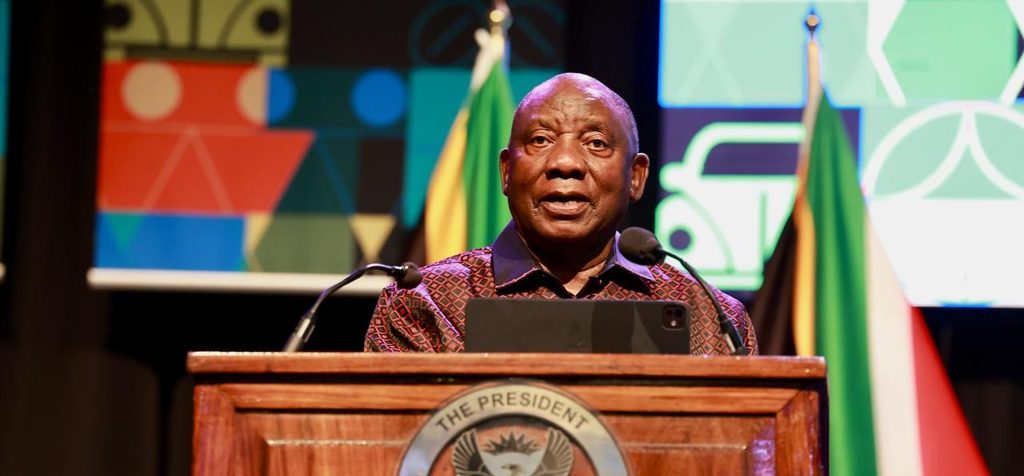
President Cyril Ramaphosa has called for stronger cooperation between government, business and labour.
He said this is essential as South Africa positions its automotive industry for the next phase of manufacturing.
Speaking at a gala dinner in Kariega last night, Ramaphosa said South Africa must build on its established manufacturing base and skilled workforce.
He also pointed to the country’s mineral resources as the global industry shifts towards electric, hybrid and other new-energy vehicles.
He said the automotive sector remains critical to economic growth, exports and job creation.
The industry supports more than 115,000 direct manufacturing jobs and more than half a million jobs across the automotive value chain. It contributes just over 5% to South Africa’s gross domestic product and exports vehicles to 155 destinations.
Ramaphosa said the manufacturing plant in Kariega had produced almost five million vehicles over 75 years, including the Beetle, Kombi, Golf, Jetta, Citi Golf, Polo and Polo Vivo.
Last year, more than 156,000 vehicles were produced at the plant, with almost 120,000 exported to markets around the world.
He welcomed a R4 billion investment linked to the introduction of the new Volkswagen Tengo, which will become the third model produced in Kariega alongside the Polo and Polo Vivo.
“It is a vote of confidence in our workers. It is a vote of confidence in our manufacturing capability. And it is a vote of confidence in South Africa as an investment destination,” Ramaphosa said.
He also highlighted more than R800 million in social investment in communities around the plant.
This includes the LEAP 9 Maths and Science School in KwaNobuhle, as well as initiatives with the Department of Basic Education focused on early childhood development and mathematics and science skills.
The company also invests R40 million annually in the Youth Employment Service, which gives unemployed young people their first experience of work.
Ramaphosa said South Africa must ensure that the transition to new-energy vehicles creates opportunities across the economy.
“We are determined to ensure that South Africa remains an important global manufacturing base for the vehicles of the future,” he said.
Government is reviewing the South African Automotive Masterplan and the wider automotive policy framework.
Discussions involving industry, unions and government are aimed at developing a common programme to grow and sustain the sector.
Ramaphosa said the country needs a plan that addresses constraints, unlocks opportunities, develops skills and provides policy certainty.
He said the goal should be to increase vehicle production locally and ensure more vehicles sold in South Africa are manufactured in the country.
Greater participation by black industrialists and South African companies is also needed, particularly in emerging areas such as batteries and electronics.
“We must not only assemble the vehicles of the future. We must increasingly manufacture the components, process the materials and develop the skills and technologies that go into them,” Ramaphosa said.
He also pointed to the African Continental Free Trade Area as an opportunity to develop larger markets and regional automotive value chains.
South Africa, he said, should remain an important manufacturing base for vehicles made for the local market, Africa and the rest of the world.
“As the global industry transitions towards new-energy vehicles, we want South Africa to be part of Volkswagen’s future technology and manufacturing strategy,” Ramaphosa said.
He said investment decisions being made now would influence where the vehicles of the next decade are manufactured.
Ramaphosa also acknowledged the contribution of workers, suppliers, organised labour and surrounding communities to the development of the automotive industry.
“The true value of industrial investment is therefore not measured only by the number of vehicles that leave a production line. It is measured by the skills that are developed, the businesses that are created and the opportunities that are opened for young people,” he said.
He called for the partnership between government, business and labour to be strengthened as South Africa prepares for the future of manufacturing.