Yasmin Bilal
President Cyril Ramaphosa has urged governments to treat quality education as a global priority. Addressing world leaders, he called for stronger education systems and greater investment in future generations.
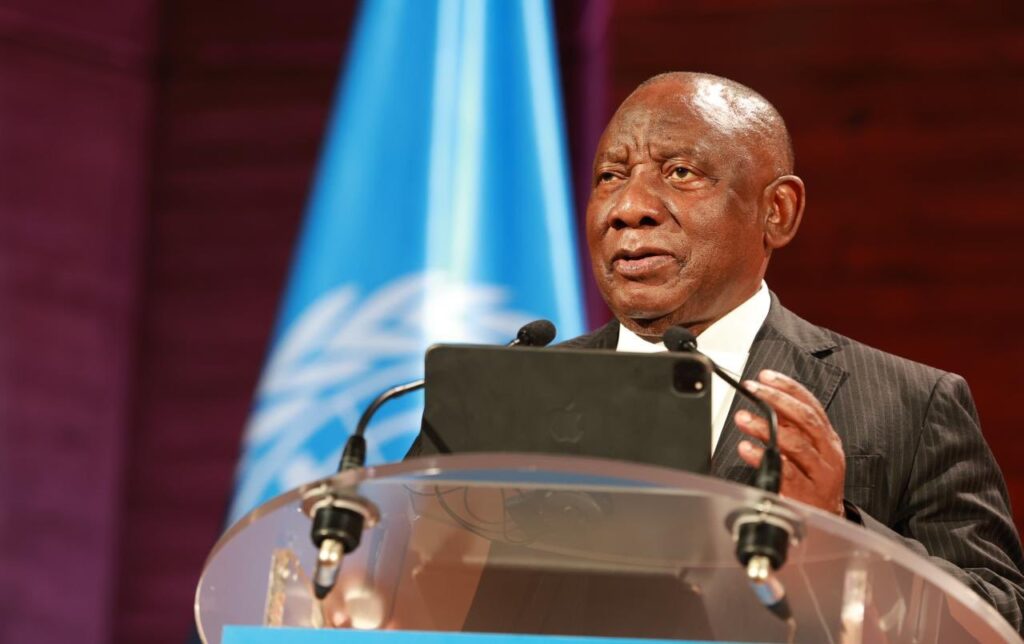
Speaking at the SDG4 High-Level Steering Committee Leaders Group meeting at UNESCO headquarters in Paris, France, today, Ramaphosa said education is the foundation on which all other development goals are built.
“SDG 4 occupies a unique position in that it is the bedrock and the enabler of the other SDGs. It is a catalyst for expanding human capability, unlocking opportunity, and delivering progress across the full ambition of Agenda 2030,” said Ramaphosa.
He said the world is facing increasingly complex challenges. These include conflict, poverty, inequality, pandemics and the growing impact of climate change. As a result, quality education has become more important than ever.
“Inclusive and equitable quality education is the key to building resilience and to fostering sustainable societies,” he said.
Ramaphosa said governments must continue investing in education if they want to create resilient societies and stronger economies. He identified foundational and lifelong learning, support for teachers and digital transformation as the three priorities that should guide future action.
He said learners cannot thrive without well-equipped teachers and quality learning environments. He added that technology has become an essential part of modern education and preparing young people for the future.
“Digital transformation in education is a non-negotiable if we are to adequately prepare today’s learners for the workplaces, economies and societies of the future,” he said.
The President also called for changes to the way education is financed. He said countries should adopt long-term funding models that strengthen national education systems. He added that sustainable investment is more effective than fragmented funding.
Ramaphosa warned that corruption, poor planning and weak financial management continue to undermine education systems by diverting resources away from classrooms.
“We know that in far too many instances globally, scarce financial resources that could be invested in education are being lost or whittled away due to mismanagement, corruption and poor planning,” he said.
He said education must remain a public good and should never become a privilege reserved for those who can afford it.
“Education is a public good. As such, it must be safeguarded against commodification, and from becoming a privilege that excludes millions of people on account of geography, age, income, gender or personal circumstances,” he said.
Ramaphosa also urged governments to give young people a greater role in shaping education policies and future learning systems.
“Young people must be treated as co-creators and not only beneficiaries,” he said.
Reflecting on South Africa’s G20 Presidency, Ramaphosa said the country had championed quality foundational learning, strengthened support for the teaching profession and promoted greater recognition of qualifications and skills across borders.
He encouraged member states to maintain that momentum and ensure global commitments are translated into real improvements in classrooms.
“Let us leave Paris today with the resolve to turn the decisions of this Committee into the daily reality of every learner. The generation of today and the generations of the future are counting on us to build and deliver education systems worthy of their promise,” said Ramaphosa.