Yasmin Bilal
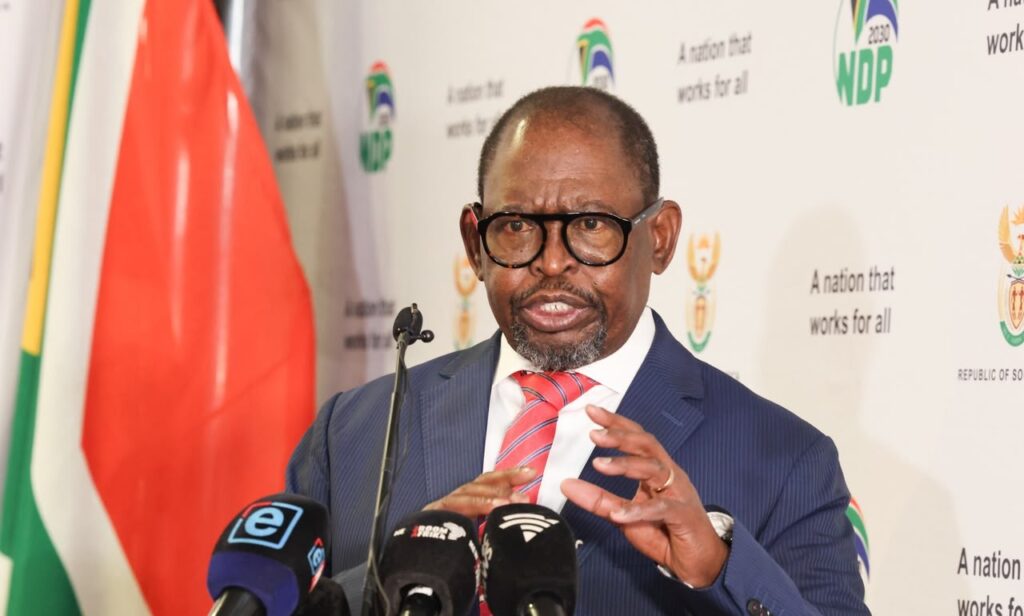
Finance Minister Enoch Godongwana has described the withholding of equitable share transfers to 69 municipalities as a necessary step to restore accountability. He said the intervention is aimed at improving financial management in local government.
Speaking to the media today in Pretoria, Godongwana said the decision followed years of poor governance, weak financial controls and repeated failures by municipalities to meet their legal obligations.
“It is against this backdrop that the National Treasury has taken the extraordinary but necessary step of temporarily withholding the July equitable share transfers to sixty-nine municipalities,” he said.
“This decision is not punitive. It is corrective. It is designed to instil fiscal discipline, protect public money, and ensure that municipalities comply with the law,” he said.
Godongwana said municipalities are responsible for delivering essential services such as water, electricity, sanitation, housing and roads.
He warned that growing financial instability is making it increasingly difficult for many councils to fulfil that responsibility.
He said the crisis cannot be blamed solely on rising costs or weak local economies. Internal weaknesses, poor governance and a lack of accountability have also contributed to the deterioration of municipal finances.
“A significant portion relates to the internal organisation of municipal finance itself. Many councils continue to adopt unfunded budgets, fail to process unauthorised, irregular, fruitless and wasteful expenditure through their Municipal Public Accounts Committees, and neglect consequence management,” he said.
Despite years of guidance, training and support from National Treasury, many municipalities continue to adopt unfunded budgets. Others have failed to settle debts owed to Eskom, water boards, the South African Revenue Service, the Auditor-General and pension funds.
Godongwana said municipalities have accumulated R24.12 billion in fruitless and wasteful expenditure since the 2021/22 financial year. Irregular expenditure has reached R145.21 billion. Of that amount, R40.14 billion was recorded during the 2024/25 financial year alone.
Municipalities have also disclosed R118.13 billion in unauthorised expenditure. Nearly half of South Africa’s municipalities adopted unfunded budgets during the 2024/25 financial year.
He said unpaid municipal debt continues to place pressure on essential service providers.
“By year-end, municipalities owed R3.40 billion in interest to Eskom and R1.21 billion to water boards, while 48 municipalities had overdue third-party deductions,” he said.
Godongwana warned that continued non-payment threatens the financial sustainability of bulk suppliers. It also disrupts service delivery and increases costs through penalties and interest charges.
“We are fighting to improve governance within municipalities, and with it the quality and consistency of service delivery, as well as to deal with the pernicious culture of non-payment,” he said.
To protect essential services, National Treasury will redirect portions of the withheld funding directly to Eskom, water boards and other statutory bodies. Municipalities that meet Treasury’s conditions will have their equitable share allocations restored.
“Funds are being redirected in tranches directly to Eskom, water boards, and statutory bodies to safeguard electricity, water, and pensions. Municipalities that demonstrate compliance will see their transfers reinstated,” he said.
Municipalities will be expected to adopt funded budgets and reduce irregular expenditure. They must also strengthen oversight through their Municipal Public Accounts Committees and implement consequence management where financial misconduct has occurred.
Godongwana said National Treasury will continue working with municipalities, provincial treasuries and the Department of Cooperative Governance. The aim is to strengthen financial management and rebuild confidence in local government.
“This is not a one-off intervention. It is part of a broader effort to restore credibility, accountability, and sustainability in local government,” he said.